Welcome to Secretariat’s third edition of Rebuilding Ukraine, where we explore the evolving landscape of Ukraine’s reconstruction, the challenges ahead, and the opportunities emerging. Stay informed with our insights on Ukraine’s Emerging Risks, Funding and International Support, and Sanctions & Export Controls.
Emerging Risks: In this edition, we provide updates from the National Agency on Corruption Prevention (NACP), the National Corruption Bureau of Ukraine (NABU), and the Specialized Anti-Corruption Prosecutors office (SAPO) in Ukraine.
Funding & International Funding: The EU and UK have increased and extended financial support to Ukraine, including loans and grants for defense, infrastructure, civil society, and independent media. Meanwhile, US military funding to Ukraine is currently paused.
Sanctions & Export Controls: The US and Europe are taking divergent approaches to sanctions on Russia. While the US is considering the potential lifting of some sanctions, Europe is intensifying its measures with the 17th Sanctions package currently underway.
Emerging Risks
Businesses and investors/funders in Ukraine will face many challenges common to conflict zones, such as corruption, regulatory uncertainties, and infrastructure deficiencies. These factors, along with the constantly evolving sanctions and international relations, contribute to a complex risk profile for governments, NGOs, and businesses operating in or considering investment in Ukraine. We explore the multifaceted nature of these business risks, offering insights into the challenges in this volatile region.
This month, the combined actions of the NACP, NABU, and SAPO against individuals, government officials, and businesses have heightened concerns about risk in areas such as bribery and corruption, contractual risks, money laundering, organized crime, and governance. Notably, these agencies have identified significant risks and vulnerabilities in public procurement and defense fortifications. The NACP has also initiated lifestyle monitoring of state tax officials to detect unjust enrichment. Additionally, NABU and SAPO have uncovered high-profile corruption and bribery schemes in key sectors such as defense, construction, procurement and energy, as well as illicit enrichment leading to state revenue loss.
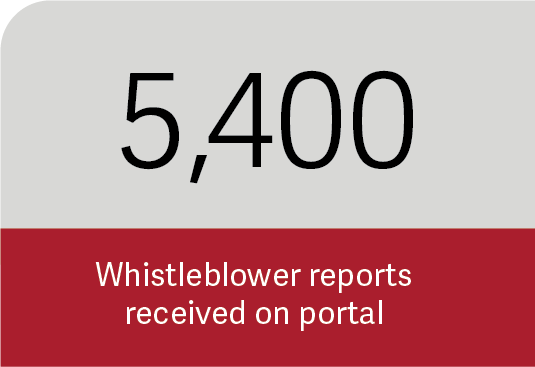
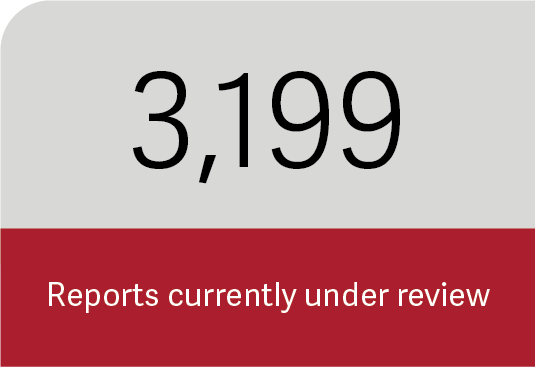
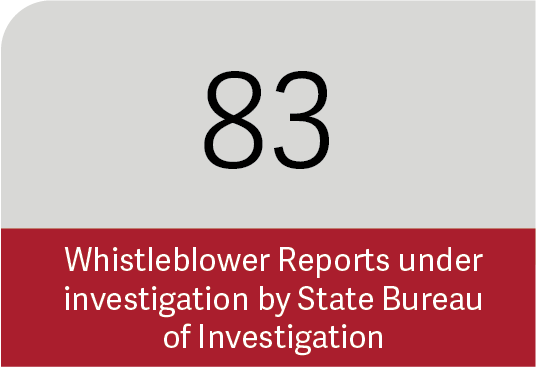
The unified whistleblower reporting portal, established by the NACP, has received over 5,000 complaints of corruption. Of these, 68% pertain to corruption-related administrative offenses defined in Chapter 13-A of the Code of Administrative Offenses, 24% involve corruption-related criminal offenses defined in the note to Article 45 of the Criminal Code of Ukraine, and a further 8% concern other corruption-related violations of the law. The NACP’s whistleblower initiative highlights its crucial role in raising awareness and improving transparency and accountability in Ukraine.
The NACP has identified vulnerabilities in the construction of defense fortifications and public procurement. They are currently studying corruption risks in reconstruction efforts, particularly in the Zaporizhzhia region. Read the full article.
A lifestyle monitoring exercise conducted by the NACP and the State Bureau of Investigation (SBI), along with evidence from independent sources, revealed that a state tax official had unjustly acquired assets beyond their regular means. Prosecutors are seeking to recover these assets for the state. Read the full article.
NABU and SAPO have uncovered a bribery scheme involving a State Border Guard Service officer who used an intermediary to bribe a law enforcer with USD 355k in USDT cryptocurrency to avoid exposure of his illegal activities. Read the full article.
NABU and SAPO charged the former deputy minister of agrarian policy and a district state administration deputy head with abuse of office and forgery, causing millions in state damages. In 2018, they illegally secured UAH 27 million (USD 0.6 million) in state aid for a plant-growing enterprise, falsely claiming it was for planting material. In fact, the funds were used as contribution to the company’s charter capital to be paid up by the founder. Read the full article.
The National Agency on Corruption Prevention (NACP) has reported an administrative offense by the former head of the Vasylkiv City District Court of Kyiv Region for failing to disclose a conflict of interest. The Supreme Court upheld a decision to confiscate part of the ex-judge’s apartment, valued at over UAH 3.6 million (USD 0.09 million), recognizing it as an unjustified asset. Read the full article.
The funding and investment into Ukraine aims to not only alleviate the immediate impacts of the conflict, but also to pave the way for long-term stability and growth. By examining the various avenues of funding and international support, we provide an overview of the international collaborative efforts to rebuild and strengthen Ukraine’s economy and infrastructure.
Reconstruction Funding Needs
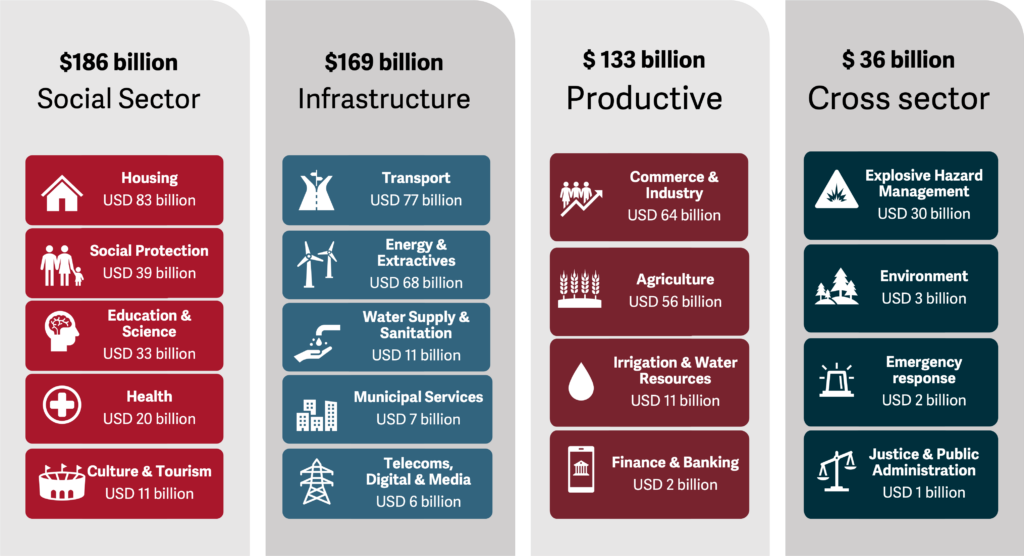
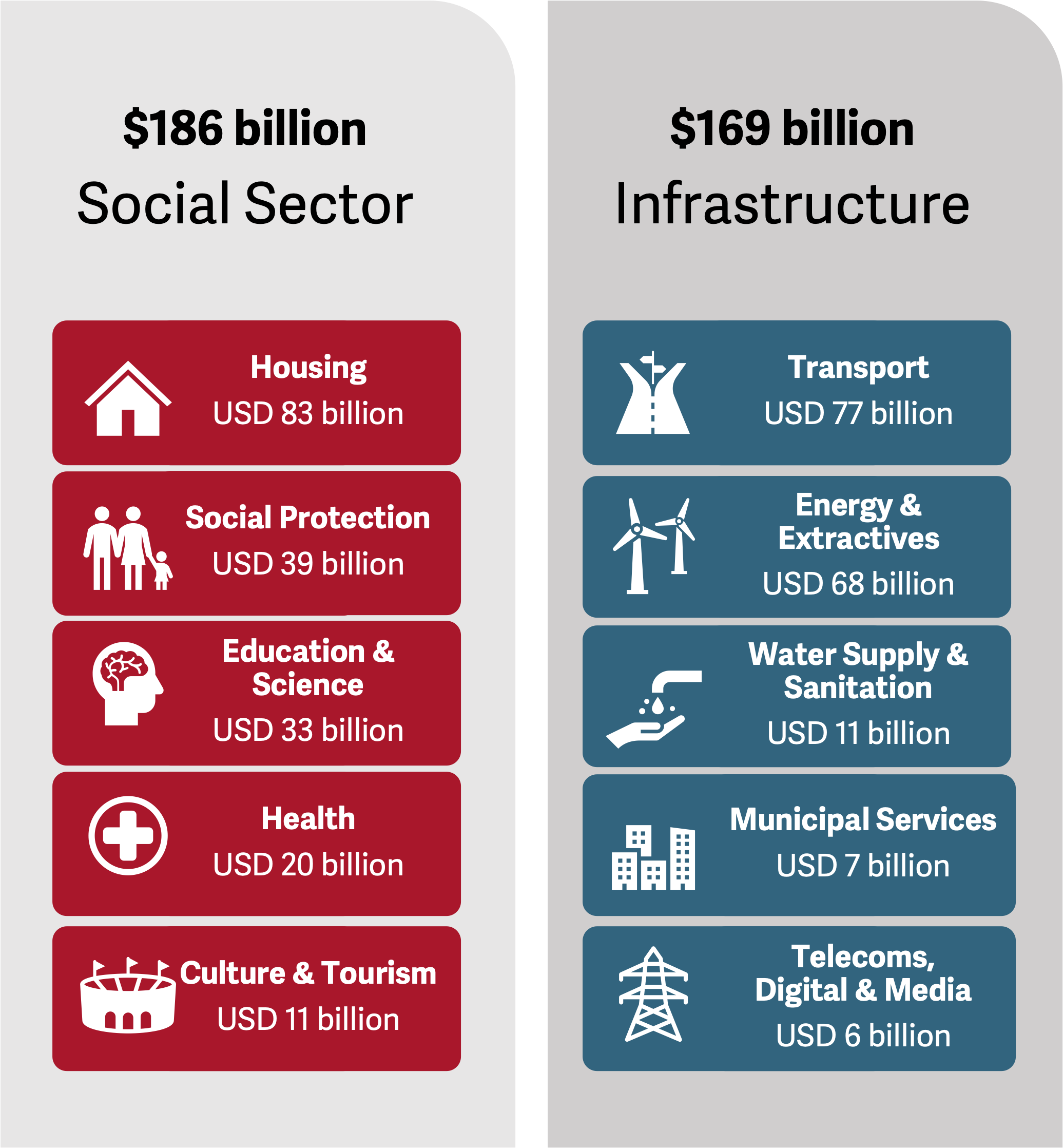
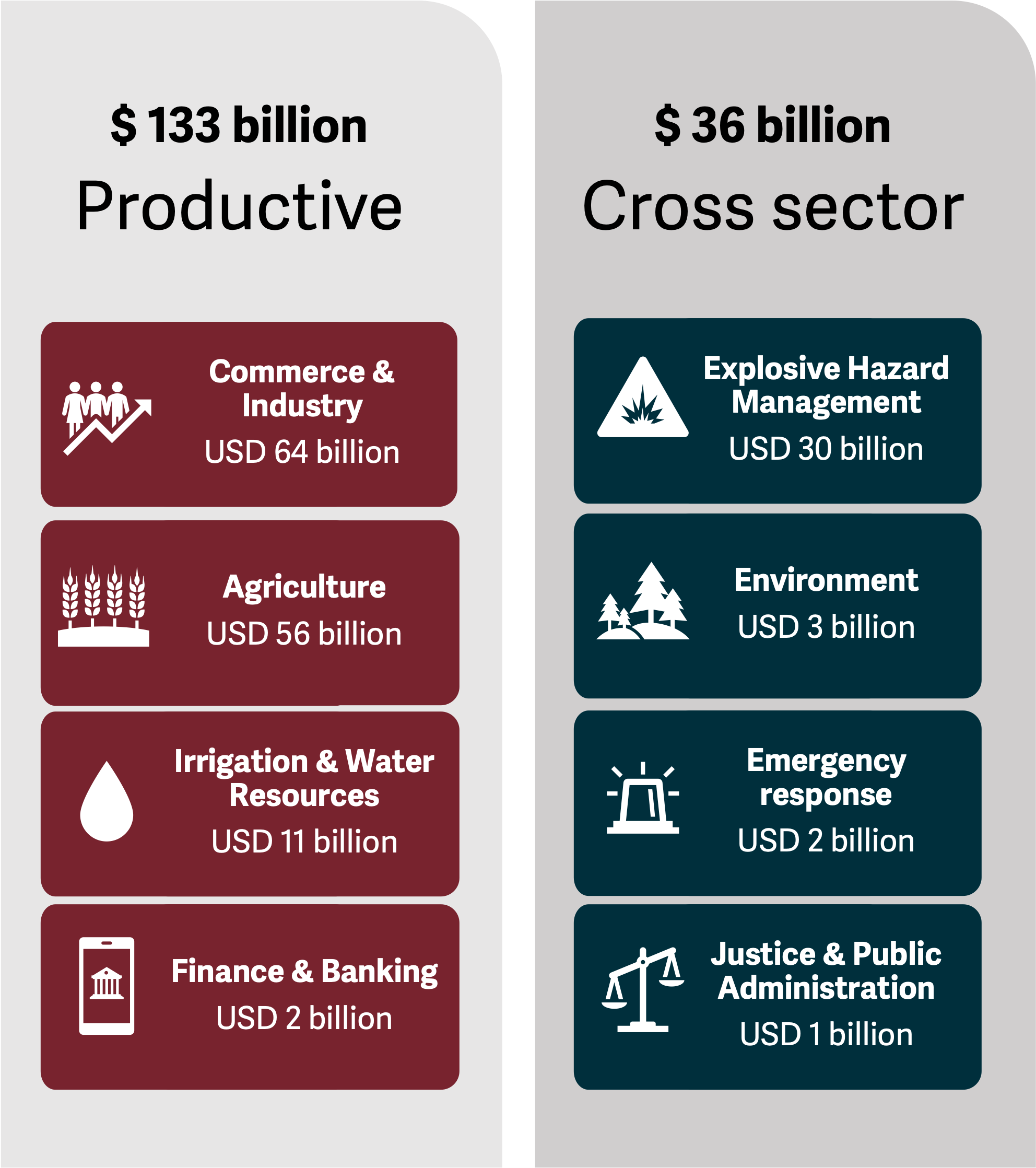
The cost of Ukraine’s reconstruction and recovery is now estimated at USD 524 billion (up from USD 486 billion), an increase of 8%, according to the Fourth Rapid Damage and Needs Assessment (RDNA4) published in February 2025. According to the RDNA4, the recovery and reconstruction investment projects for 2025 is estimated at USD 17.32 billion, with USD 7.4 billion funding secured. Despite these efforts, a significant financing gap remains, underscoring the need for continued and increasing international support. Ukraine’s sector-wide summary of needs is represented in the chart below.
Ukraine Critical Sector Funding Needs
International Aid & Support
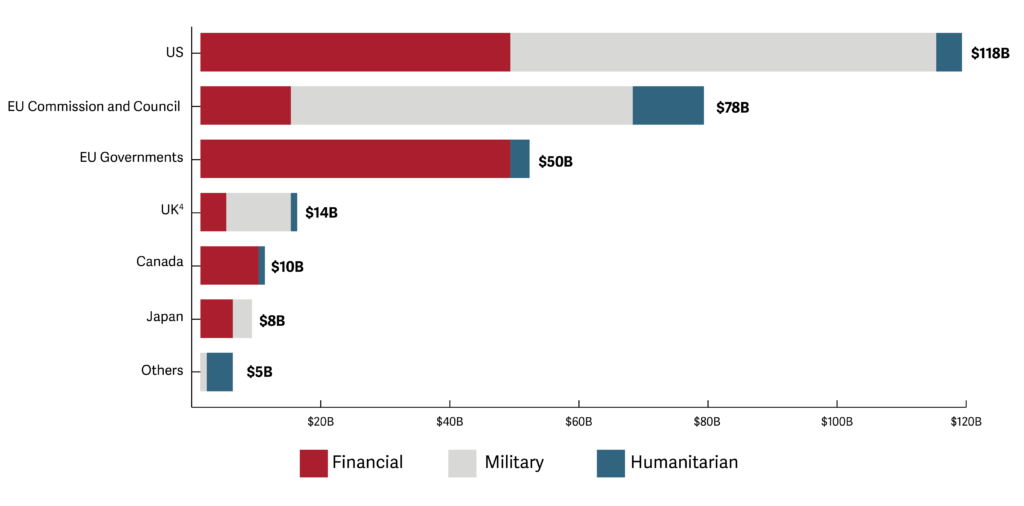
USD 283 billion of international aid was invested into Ukraine after December 2024 — for financial, military, and humanitarian needs (USD 239 as of 31 October 2024).
US military funding to Ukraine was suspended on 3 March 2025 following the meeting between US President, Donald Trump, and the Ukrainian President, Volodymyr Zelenskyi in Washington, DC on 28 February 2025. Read the full article.
The European commission disbursed a EUR 1 billion (USD 0.9 billion) tranche as part of its Macro-Financial Assistance (MFA) loan to Ukraine. With this payment, the Commission’s total lending to Ukraine under this MFA reached EUR 4 billion (USD 4.3 billion). Read the full article.
The European Commission and European Investment Bank (EIB) Group signed a EUR 2 billion (USD 2.15 billion) guarantee under Ukraine Facility in support of the country’s reconstruction efforts. The financing targets critical infrastructure, such as energy, transport, housing, water, and heating, to sustain essential services and economic stability. Read the full article.
A UK-Ukraine bilateral agreement was signed on 1 March 2025. This loan of GBP 2.26 billion (USD 3 billion) will bolster Ukrainian military capabilities. The loan will be repaid using profits generated on sanctioned Russian sovereign assets. Read the full article.
The EU, along with member states Sweden and Germany, announced EUR 44 million (USD 47 million) in funding to support civil society organizations (CSOs) in Ukraine. This includes EUR 6 million (USD 6.5 million) for gender leadership and conflict initiatives as part of Europe’s long-term strategy to strengthen democratic processes, social cohesion, and sustainable development. Read the full article.
The EU announced a EUR 10 million (USD 10.8 million) package in the form of sub grants for independent media to ensure their sustainability in Ukraine such as Internews Europe, Reporters Without Birders, the Institute for Mass Information, Black Sea Foundation, and Docudays festival. Read the full article.
Targeted sanctions and export control regimes aim to constrain Russia’s ability to sustain its military operations. These measures have expanded to cover a wide range of individuals, entities, and sectors critical to Russia’s economy and war effort. Key targets include major financial institutions, energy companies, defence contractors, and high-profile political figures.
Tanner Weil provided an expert report and testimony on behalf of Air Liquide, a multinational supplier of industrial gases and related services, in a construction dispute arbitration surrounding the development and construction of an anaerobic digester biogas facility in Pennsylvania. The unanimous arbitration panel awarded more than $25.4 million, an amount determined directly from Mr. Weil’s analysis and testimony.
With deep expertise in survey research, sampling, and statistical analysis, Dr. Iyengar expands Secretariat’s capabilities in high-stakes intellectual property, class action, and commercial disputes.
During Peru’s 2026 presidential election, Secretariat’s Arnold Y. Castillo was retained by a major political party to conduct an independent assessment of identified anomalies and determine whether the available evidence justified further technical scrutiny.