This year, a series of landmark transactions reshaped ownership across the Indian Premier League (IPL), with Royal Challengers Bengaluru (RCB) reportedly sold at a valuation of approximately $1.78 billion1,2 and Rajasthan Royals at approximately $1.6 billion.3 These billion-dollar deals, involving a mix of global institutional investors, strategic buyers, and private equity participants, mark a defining moment in the commercialisation of franchise cricket and signal the IPL’s emergence as a mature, investable global sports asset.
Launched in 2008, the IPL fundamentally transformed how cricket is consumed and monetised. Its shorter match durations, city-based franchise structure, international player participation, and media-first approach have aligned the sport with modern, on-demand viewing habits. Against this backdrop, the recent transactions not only underscore the league’s strong financial trajectory but also frame the key question explored in this article: what structural features make the IPL one of the most attractive investment opportunities in global sport?
First, the entry of institutional private equity, most notably Blackstone, as part of the consortium acquiring RCB4, marks a structural shift in the investor base and establishes IPL franchises as a scalable, long-term investable asset class.
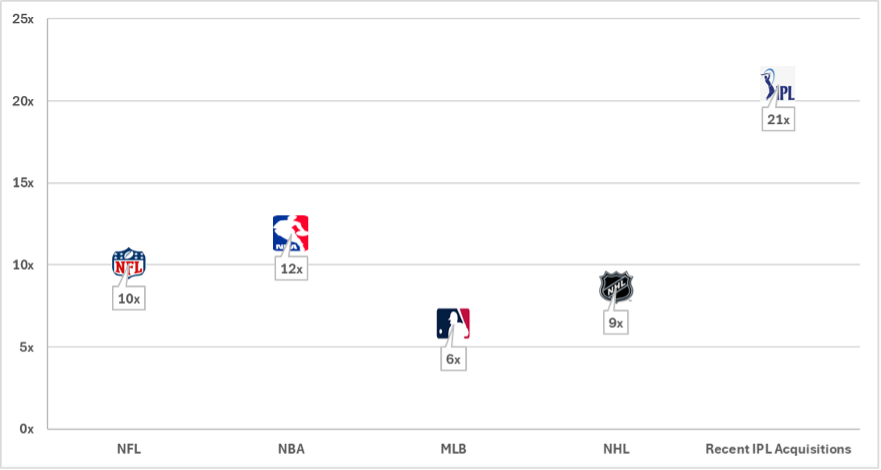
Second, these valuations imply price-to-revenue multiples in the range of 20x to 22x.5 By comparison, S&P Global (the parent company of the S&P 500 Index in the United States and a financial intelligence and analytics corporation) notes that price-to-revenue multiples for top-tier teams typically sit in the low double digits, with franchise valuations having accelerated sharply over the past decade, outpacing growth seen in prior periods.6 Recent transactions illustrate the valuation levels being paid for established North American franchises. For example, the Milwaukee Bucks were sold at a price-to-revenue multiple of approximately 9.9x, while the Boston Celtics were valued at approximately 13.3x revenue in their recent transaction.7 This valuation premium reflects the IPL’s positioning and growth potential compared to leading sports leagues such as the National Football League (NFL) and English Premier League (EPL).
Figure 1: Implied Average Revenue Multiples for North American Leagues vs Recent Acquisition of IPL Teams
In this article, the authors examine certain key factors underpinning the attractiveness of IPL franchises as an investable sports asset, including the adoption of advanced broadcast technology, premium media rights valuations, capital-light operating model, predictable profitability and, subject to potential cross-league regulation, the ability for investors to build multi-team portfolios across global cricket leagues.
The IPL was built for a digital and high-definition broadcast era, allowing it to integrate advanced production and analytics technologies earlier in its lifecycle than legacy leagues, which had to retrofit innovation onto established broadcast ecosystems. For instance, cricket broadcasting incorporated technologies such as ball tracking (Hawk-Eye),8 the Decision Review System (DRS), and real-time analytics overlays into mainstream coverage by the late 2000s and early 2010s. The adoption of 4K streaming and immersive audio has further enhanced engagement.9 Notably, the IPL, along with its streaming partner JioCinema, also pioneered a free-to-consumer, ad-supported (AVOD) streaming model at scale.10 By contrast, leagues such as the NFL only began scaling comparable player tracking and data-driven broadcast systems (Next Gen Stats) from the mid-2010s onward, with further integration of optical tracking technologies such as Hawk-Eye emerging only in the 2020s.11
The annual IPL media rights were sold for about $1.2 billion, making each IPL game worth over $17 million per match, second only to the NFL ($37 million) in terms of per-match value among major sports leagues, and making it more valuable than the EPL ($10 million), which sits right below the IPL in terms of value of media rights per match.12Digital reach during the IPL season hit 652 million viewers, a 28% year-on-year increase,13 while total viewing time exceeded 514 billion minutes.14 IPL advertising and sponsorship revenues have also expanded sharply. In 2025, total advertising revenue associated with the league was expected to cross $600 million, representing around a 50%increase from the previous year.15
The most dramatic revenue impact came from the IPL’s pivot to large-scale digital streaming. The move to a free, ad-supported over-the-top (OTT) model enabled the league to unlock audiences far beyond the limits of pay television. Digital platforms allowed for dynamic ad insertion, frequency optimisation, and audience segmentation, making IPL advertising more measurable and efficient than traditional TV spots.16
What also works in favour of cricket commercially is that it offers broadcasters a large ad-inventory per match due to its format. A cricket match has strategic timeouts, short breaks at the end of every over and at the fall of each wicket, and a long inning breaks, which all add up to a larger inventory for advertisements compared with football or basketball, where breaks are rather limited.17
As IPL franchise valuations have surged, available financial data suggests that it is backed by most teams being profitable in recent years, particularly following the step-up in media rights revenues from the 2023–2027 cycle. Industry estimates indicate that leading franchises generate annual revenues in the range of $60 million to $85 million, with profits typically in the range of $12 million to $25 million (₹100 crore to ₹200 crore).18 At least five IPL franchises have doubled revenues since 2022, with multiple teams also reporting significant increases in profits.19
A major structural distinction between the IPL and legacy sports leagues lies in how teams approach stadium ownership and capital expenditure (capex). In leagues such as the NFL, MLB, and EPL, franchises and governing bodies routinely invest billions of dollars in state-of-the-art stadiums and arenas, which serve both as competitive assets and major revenue generators but also significantly increase fixed costs and balance-sheet risk. For example, the NFL’s SoFi Stadium in Los Angeles (home to the Rams and Chargers) is widely reported as the most expensive sports stadium ever built at approximately $5.5 billion,20 while some other NFL stadiums have cost around $2 billion each to construct21, and top football facilities like the Tottenham Hotspur Stadium in London have cost more than $1.3 billion.22
By contrast, IPL franchises operate in a capex-light model where teams typically lease existing stadiums owned by state cricket associations or municipal bodies. IPL teams pay relatively modest rent for use of grounds, which amounts to a small fraction of overall operating expenses, with stadium rent often accounting for less than 1% of total costs for a franchise.23
This capex-light model has clear advantages; however, it also brings significant risk. A significant measure of each IPL team’s success and fan engagement is derived from its ties to a city within India, and, when access to its home ground is governed by lease agreements with stadium owners, be it a state association, a public-linked body, or a private entity, contract renewal becomes a major leverage point for the relevant landlord.
A core risk must be noted for IPL franchises not acting as stadium owners, in contrast to what we typically see in the NFL, MLB, and EPL leagues: the risk of renegotiation with state actors and high level of diligence that follows for potential investors. In simpler terms, while the capex-light model can improve upfront investment, it leaves the door open for mid-term risks of rent increases, operational constraints, and adverse renewal terms.
This is one of the most underappreciated considerations on IPL franchise valuations. Stadium ownership acts as an additional revenue source beyond the match day or season revenue and enables franchises to possess long-term naming rights, provide hospitality and premium experiences, put up permanent signage and branding, and allow for non-match day related activities ranging from stadium tours, museums, retail, and concerts.
While leagues in the U.S. and Europe maintain stadium ownership as more than real estate and capitalise on this, the IPL model does not afford it any further recognition. In a league such as the IPL, a large part of the franchise revenue flows from a central revenue pool, including media rights and title sponsorships, that is handled by the Board of Control for Cricket in India (BCCI). Franchises here are contractually allocated a specified percentage of this central pool and, in addition to this, generate revenue only through sources such as ticket and merchandise sales. Given this structure, stadium ownership and monetisation would see franchises owning and operating a year-round entertainment asset and remove the risk of BCCI revenue distribution rules or shifts in the broadcast media market.
Alongside the rise of the IPL, cricket’s global expansion has been accelerated by the introduction of new formats designed specifically for modern audiences, shorter attention spans, and broadcast efficiency.
The most prominent of these is The Hundred, launched by the England and Wales Cricket Board (ECB) in 2021. Featuring 100-ball innings, simplified rules, city-based teams, and mixed-gender doubleheaders, The Hundred was designed as a broadcast-friendly product aimed at families, younger fans, and viewers unfamiliar with cricket’s traditional formats. From a commercial perspective, the inaugural season attracted over 16 million viewers in the UK, making it one of the most-watched domestic cricket competitions in British history.24 In 2023 and 2024, private equity firms and IPL franchise owners acquired minority stakes in several Hundred teams, valuing the league at approximately £1 billion ($1.2 billion).25 These investments, which saw individual teams valued in the £80 million to £120 million ($96 million to $144 million) range,26 underscored growing confidence in short-format cricket as a scalable global product.
Beyond The Hundred, other formats and innovations continue to reshape cricket’s landscape. T10 leagues, offering matches lasting roughly 90 minutes, have emerged in markets such as the Middle East and Europe, positioning cricket closer to the duration of sports like basketball or football.
At the same time, women’s cricket has benefited from these new formats as well. Both the Women’s Premier League (WPL) in India and the women’s competition within The Hundred have leveraged shorter formats, centralised scheduling, and strong broadcast visibility to achieve record attendance and viewership figures using the double header format. This expansion not only broadens cricket’s demographic appeal but also adds incremental revenue streams that strengthen the sport’s overall commercial ecosystem.
By 2025, the cross-pollination between the IPL and The Hundred had deepened significantly, with three major IPL ownership groups completing substantial acquisitions. RPSG Group (owners of Lucknow Super Giants) purchased a 70% controlling stake in Manchester Originals for approximately £75 million ($101 million). Reliance Industries (Mumbai Indians) acquired a 49% stake in the Oval Invincibles for approximately £60 million ($78 million),27 Sun Group (Sunrisers Hyderabad) completed a full 100% acquisition of Northern Superchargers from Yorkshire for £100 million ($130 million),28 The GMR Group (Delhi Capitals) had already acquired Hampshire’s Southern Brave in 2024, purchasing the remaining 49% stake for approximately £48 million ($62.4 million).29 Taken together, these transactions mean that the majority of The Hundred’s franchises are now owned or co-owned by IPL groups, creating a deeply integrated ownership ecosystem.
The IPL’s influence now extends beyond technology and format adoption to cross-league ownership, a model that further accelerates standardisation, data sharing, and commercial scalability across global cricket. Leading IPL franchises now own or operate teams across multiple leagues, including The Hundred in England, Major League Cricket (MLC) in the United States, the SA20 in South Africa, the ILT20 in the UAE, and the Caribbean Premier League30. This cross-league ownership enables faster transfer of best practices in analytics, sports science, fan engagement technology, broadcast production, and commercial execution, mirroring the multi-club ownership models increasingly seen in global football.
Manchester Super Giants (was previously: Manchester Originals)
Punjab Kings
St Lucia Kings
–
–
–
–
However, questions on whether such forms of ownership can complicate competition, player contracts, or general information flowing across different leagues remain unanswered. Adding to the issues, the IPL regulations do not in any manner undertake to define nor do they refer to a concept of “control”. This leaves scope for the allocation of control to be dealt with only in contractual frameworks, such as franchise agreement provisions on ownership restrictions, rather than as a governance mandate.
In stark contrast to the lack of a detailed integrity regime in the IPL and BCCI is the Union of European Football Associations (UEFA) integrity frameworks. The UEFA’s integrity rules governing club competitions go so far as to prohibit an individual or entity from having any “control or influence” over more than one participating club, defining that by reference to majority voting rights, board appointment/removal rights, or being able to exercise “decisive influence”, among other things.32 Of course, the primary differences in this contrast are UEFA’s role as a multi-jurisdictional regulator and the cross-league competitions it oversees — neither of which applies to the BCCI, which is a national body. That said, the BCCI33 is the regulator of the leading global T20 tournament, and if T20 cricket leagues were to one day develop cross-league competitions akin to what has developed in the European football world (like the erstwhile Champions League T20),34 critical sporting governance and integrity frameworks would need to be implemented, which would doubtless impact existing investments and could significantly alter the current risk profile.
A more realistic near-term route might involve mandatory disclosures regarding cross-league holdings and appropriate ring-fencing mechanisms, rather than instituting an outright ban. Such hard measures would lead to suppression of investment and reduction in franchise valuations, which would ultimately deter the growth of the sport.
If cricket moves towards a defined cross-league competition structure, the impact felt on league economics and investors could be immediate. At the outset, this could trigger a forced restructuring or divestment for existing players like Reliance Industries, India Cements, GMR Group & JSW Sports, followed by enhanced due diligence, disclosure requirements, and regulatory conditions precedents. Portfolio synergies that are used to drive investors to such cross-league ownership models may collapse and change the bottom line that brings in new investment.
While most of the above-mentioned features, such as capex-light model, centralised media rights, and fixed revenue seen in the IPL are attractive, they are deeply rooted in commercial and legal dependence on a sole body, the BCCI. What this means for investors is that the closed-league model adopted by the IPL is not to be treated as a standalone surety of protection but rather assessed as a part of a whole ecosystem in which BCCI control, consent, and discretion can change substantive operational, commercial, and legal dynamics at any given time, thereby affecting franchise economics and, by direct implication, investment performance. It is crucial for any potential investor to then scrutinise the documents presented to it before entering this closed league. Key legal considerations must be given to the franchise agreement and the allocation of rights such as long-term participation, termination, suspension rights of the BCCI, profit-sharing arrangements, and change of control processes, as well as current and anticipated regulatory platforms.
Much like the NBA, NHL, MLB, and NFL, the IPL operates as a closed league whereby all teams remain in the league regardless of their performance. The removal of this downside risk of relegation in the IPL’s closed league system is an attractive pull for investors, only multiplied by the fixed teams’ structures and centralised revenue pool. This ensures that demotion-related revenue drops do not impact the individual franchises, and it is due to this that the IPL is increasingly being seen as a high-value sports-media asset as opposed to a run-of-the-mill cricket competition. However, a critical point that requires investor due diligence in this regard is the legal durability of such a model. While the IPL’s closed-league model guarantees return on investments for investors, it also requires investors to operate within the confines of a BCCI-controlled architecture through limited elements such as franchise agreements, BCCI Constitution, IPL regulations, and related governance documents.
A commonly unnoticed yet important legal feature in most sporting ecosystems revolves around the dispute resolution mechanisms employed within the sport. When it comes to the IPL, disputes involving players and team officials are dealt with within the system. As per the 2026 IPL Code of Conduct for Players and Team Officials,35 disputes are channelled into an internal process established by the BCCI, requiring players and team officials to submit to the exclusive jurisdiction of the dispute resolution mechanism as set out in the code, and waive any and all recourse to external bodies of adjudication, which include the Court of Arbitration for Sport. In the IPL scenario, this reinforces the centralised control framework instituted by the BCCI with regard to adjudication and disciplinary matters. While this provides investors with the comfort that the IPL operates with strong and consistent procedural control, it also sheds light on how the disciplinary procedures, outcomes, appellate hearings, and reputational management are widely shaped by the BCCI without any recourse to an independent sports arbitral body. This is not to be treated as a footnote, but a more detailed diligence issue for potential investors, as internal processes dictate enforcement and affect decision-making timelines for franchises and players.
Notwithstanding the strong growth in headline league and franchise valuations, valuing cricket assets, particularly within the IPL ecosystem, remains complex. Unlike mature leagues where revenue streams are well diversified across media, matchday, merchandising, and real estate, IPL valuations are heavily concentrated in centralised media rights and sponsorship income. This concentration increases sensitivity to media rights cycles, regulatory changes, and shifts in broadcaster strategy.
When valuing sports teams, it is therefore critical to identify which factors drive durable cash flows as opposed to short-term performance spikes, and to assess how league structures—such as the IPL’s closed-league model, centralised media rights, and capex-light stadium arrangements—limit downside risk while enhancing operating leverage. Independent valuation analysis helps investors and stakeholders distinguish between popularity and profitability, ensuring that franchise values reflect not only current revenues but also the resilience, scalability, and long-term monetisation potential embedded in the league’s business model.
Cricket has unquestionably evolved from a regional sport into a global contender. Whether it can cement itself as the next truly global mega-sport, alongside football and the NFL-style league model, will depend less on headline numbers and more on economic resilience. The audience is there. The technology is in place. The capital has flowed. Only time will tell whether the business of cricket can keep pace with the scale of its ambition.
All figures presented herein are denominated in USD, unless otherwise noted. ↩︎
Editorial Note: The Editorial Team used Claude Sonnet 4.6 to assist with creation of this table. All information in this table has also been independently verified by the author.↩︎
One can speculate whether the prospect of cross-league T20 competition is realistic and whether it would generate similar commercial dynamics as have the UEFA club competitions, as well as whether the BCCI or, more likely the ICC should exercise oversight, but the impact on multi-club ownership would remain. ↩︎
‘Champions League T20 [2026] – Schedule, Teams, Points Table, Venues’, CLT20.in, https://clt20.in/ (last accessed 9 June 2026) ↩︎
Shalabh has provided financial analyses, economic advisory, forensic accounting, quantification of damages and other litigation support services to clients and their counsel for 10 years. He is a Chartered Accountant (CA), a Certified Fraud Examiner (CFE), and a Chartered Business Valuator (CBV).
Sarab Bhatia Senior Associate | Secretariat
Sarab provides quantification of damages and other litigation support services to clients and their counsel. His experience spans across business valuations and corporate tax advisory services over last 9 years. Sarab is a CFA® Charterholder, a Chartered Accountant (CA) and a Chartered Business Valuator (CBV).
Stephen Bainbridge Shareholder | Greenberg Traurig
Steven Bainbridge, Co-Chair of the Sports Business Industry Group, has deep experience in the sports sector, advising clients on matters including governance issues, athlete endorsement agreements, player contracts, regulatory issues, broadcasting, anti-ambush marketing strategies, merchandising and licensing regulations and agreements, disciplinary issues, and sports-specific venue management agreements. He advises clients, including foreign law firms, corporate entities, government bodies, individuals, and institutions related to sports including motorsports, horseracing, triathlons, mixed martial arts (MMA), rugby and football, cycling, golf, tennis, cricket, and others.
Steve has law firm experience in both North America and Japan, in addition to his work in Dubai. In Tokyo he worked on matters related to broadcasting rights and sponsorship contracts in connection with FIFA World Cups, X-Games, PGA tour sponsorships, videogame licensing, and stadium naming rights deals.
Ananyaa Ajay Kumar Paralegal | Greenberg Traurig
Ananyaa serves as a paralegal within the Sports practice group at Greenberg Traurig’s Dubai office.
She provides comprehensive support across a variety of sports regulatory, commercial, and compliance matters. Her work extends to the review and analysis of commercial sports contracts, conducting in-depth regulatory research, and assisting on issues affecting sports organizations, governing bodies, rights holders, and other industry stakeholders across the evolving sports landscape. Ananyaa completed her Master’s in International Sports Law at ISDE, Madrid, equipping her with specialized expertise in the intricate legal frameworks governing the sports industry.
Tanner Weil provided an expert report and testimony on behalf of Air Liquide, a multinational supplier of industrial gases and related services, in a construction dispute arbitration surrounding the development and construction of an anaerobic digester biogas facility in Pennsylvania. The unanimous arbitration panel awarded more than $25.4 million, an amount determined directly from Mr. Weil’s analysis and testimony.
With deep expertise in survey research, sampling, and statistical analysis, Dr. Iyengar expands Secretariat’s capabilities in high-stakes intellectual property, class action, and commercial disputes.
During Peru’s 2026 presidential election, Secretariat’s Arnold Y. Castillo was retained by a major political party to conduct an independent assessment of identified anomalies and determine whether the available evidence justified further technical scrutiny.