Mid-Year 2025 Update: Nazaha’s Progress in the Fight Against Corruption
September 18, 2025
As part of its ongoing mandate to enhance transparency and integrity, Saudi Arabia’s Oversight and Anti-Corruption Authority (Nazaha), has continued its efforts. For the six months to June 2025, Nazaha have conducted areas of engagement into new authorities as follows:
Expanding Nazaha’s Reach
Nazaha commenced oversight and investigative activities into three authorities not previously reported:
King Fahd Causeway Authority
Saudi Ports Authority
Public Prosecution
This highlights Nazaha’s intent to broaden its mandate and scrutinize institutions of strategic national significance. This broader oversight is expected to enhance institutional accountability in cross-border operations, judicial integrity, and maritime infrastructure, critical areas for both national security and economic performance. This aligns with the Nazaha Law of 2024, which broadens investigative reach and mandates comprehensive sectoral coverage.
Strategic Resource Reallocation
In June 2025, Nazaha reported conducting 14,697 visits to holy sites during the Hajj season.
This focus on Hajj-related operations indicates a reduction in regular oversight activities during the month of June, with only around 600 non-Hajj visits conducted compared to an average of 2,300 visits in previous months. This seasonal prioritisation reflects Nazaha’s evolving enforcement model, allocating resources based on risk exposure and anticipated impact.
Targeted Enforcement in Action (H1 2025)
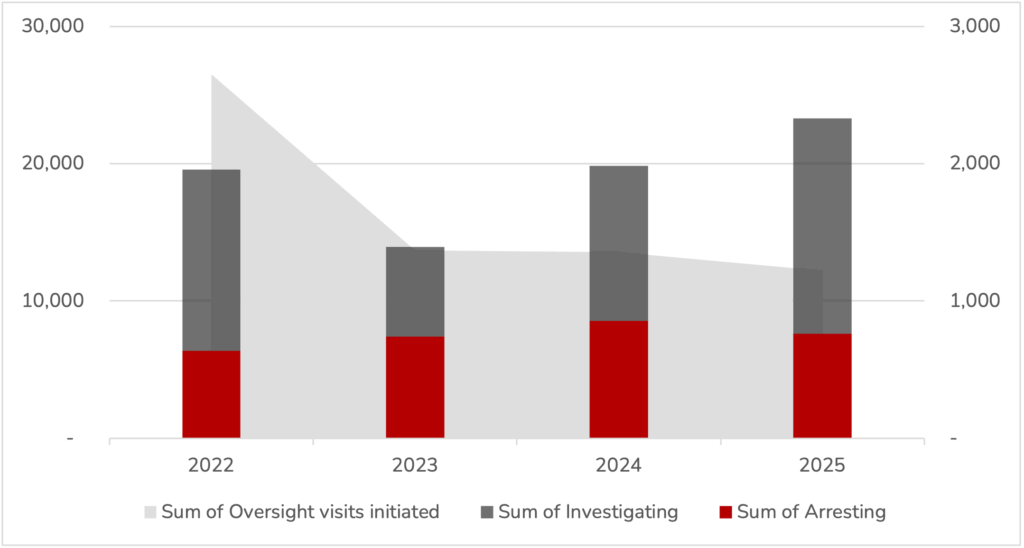
A year-on-year comparison of Nazaha’s activities during the first half of each year is shown below:
Year
Oversight Visits
Investigations
Arrests
2022
26,528
1,957
636
2023
13,703
1,394
742
2024
13,567
1,983
854
2025
12,206
2,330
761
Note: this figure does not include the visits to holy sites.
While the number of visits has slightly declined, investigative actions have reached their highest level over the four-year period. Arrest figures remain consistent, reflecting sustained legal enforcement.
Corruption Perceptions Index Improvement Signals Progress
In a further sign of progress, Saudi Arabia recorded a notable improvement in its Corruption Perceptions Index (CPI) ranking for 2024. This reflects growing international recognition of the Kingdom’s anti-corruption efforts, including recent legislative reforms and enforcement outcomes. Nazaha’s performance, both operationally and institutionally, plays a significant role in shaping these perceptions.
As confidence in public-sector integrity increases, the Kingdom is hoping to attract more foreign investment, particularly in sectors aligned with Vision 2030.
Outlook for H2 2025 and Beyond?
Continuing Progress and Alignment with Vision 2030
As highlighted in our original white paper, “Integrity and Accountability: Saudi Arabia’s Anti-Corruption Drive,” the Kingdom has made significant strides in transforming its anti-corruption framework. The ongoing developments, such as the introduction of the Nazaha Law and the strengthening of Nazaha’s oversight capabilities, were identified as key milestones in the Kingdom’s commitment to transparency and accountability. The improvements seen in the Corruption Perceptions Index (CPI) reinforce the success of these initiatives, demonstrating that the actions discussed in the earlier report are producing tangible results. This continued progress not only aligns with Vision 2030 but creating a more stable and attractive environment for both local and international investment.
In H1 2025, Nazaha also advanced its international cooperation efforts by signing a series of Memorandums of Understanding (MoUs) focused on combatting corruption and safeguarding integrity. Notably, these included cooperation frameworks with the Public Investment Fund (PIF) and the governments of Kazakhstan and Uzbekistan. These developments reflect Saudi Arabia’s intent to extend its anti-corruption practices into commercial and investment spheres, ensuring that ethical standards are maintained both domestically and across borders.
Saudi Arabia’s growing global role was further underscored by its election to the Executive Committee of the International Association of Anti-Corruption Authorities (IAACA) in early 2025. A recognition of Saudi Arabia’s proactive engagement in global anti-corruption efforts and its rising influence in international integrity forums.
If you would like to discuss any of the issues raised in this update or have questions about Saudi Arabia’s anti-corruption efforts, please reach out to Ralph Stobwasser, Dominique Dondelinger, or Tarek Bleik.
Tanner Weil provided an expert report and testimony on behalf of Air Liquide, a multinational supplier of industrial gases and related services, in a construction dispute arbitration surrounding the development and construction of an anaerobic digester biogas facility in Pennsylvania. The unanimous arbitration panel awarded more than $25.4 million, an amount determined directly from Mr. Weil’s analysis and testimony.
With deep expertise in survey research, sampling, and statistical analysis, Dr. Iyengar expands Secretariat’s capabilities in high-stakes intellectual property, class action, and commercial disputes.
During Peru’s 2026 presidential election, Secretariat’s Arnold Y. Castillo was retained by a major political party to conduct an independent assessment of identified anomalies and determine whether the available evidence justified further technical scrutiny.